

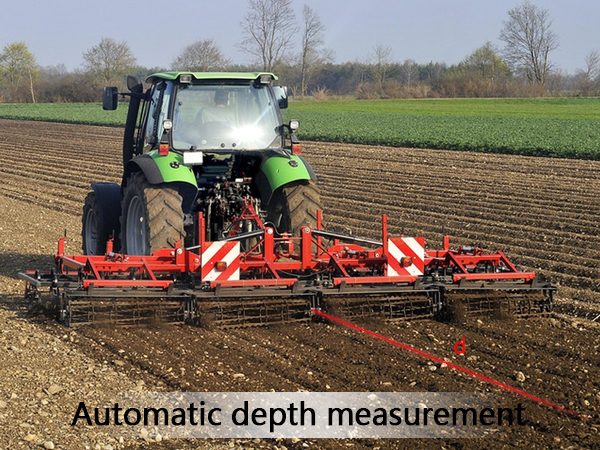
Automatic Depth Measurement Laser Sensors
Automatic depth measurement laser sensors are advanced optical ranging module devices used to accurately measure the distance or depth to a target surface in real time. The distance measurement sensor is widely used in industrial automation, robotics, quality control, 3D scanning, and automotive applications due to their high precision, speed, and non-contact measurement capabilities.
Key Features:
1. Non-contact measurement: No wear on laser length measurement sensor or damage to delicate objects.
2. High accuracy: Ideal for precision manufacturing.
3. Fast response time.
4. Real-time feedback in dynamic environments
5. Compact design: Easy integration into robotic arms, conveyors, etc.
6. Immune to ambient light interference: Reliable in bright or variable lighting conditions.
7. Can measure complex surfaces: Handles textures, angles, and curved shapes.
Common Applications:
1. Industrial Automation:
Height/ level checking on production lines
Weld seam tracking in robotic welding
Part alignment and positioning
2. Quality Control Inspection:
Detecting warping, dents, or thickness variations
Surface profiling and 3D mapping
3. Robotics AGVs:
Obstacle detection and navigation
Bin picking with depth awareness
4. Automotive Manufacturing:
Door gap and flushness inspection
Engine block and panel alignment
5. 3D Scanning Reverse Engineering:
Capturing detailed surface data for CAD models
6. Medical Devices Packaging:
Ensuring proper fill levels or seal integrity
Integration Considerations:
Mounting: Must be stable and aligned properly to avoid measurement drift.
Environmental Factors: Dust, moisture, temperature changes can affect performance of measurement laser sensors.
Data Output: Typically distance measurement sensor provides analog, digital RS485, RS232, USB or Modbus Rtu compatible with PLC and MCU.
Software Compatibility: Often paired with arduino software.
Choosing the Right Laser Measurement Sensor:
1. What is the required measurement range? (3cm to 30km)
2. How much accuracy is needed? (±1 mm or ±1 m)
3. Is the target surface reflective, dark, or textured?
4. What is the environmental condition (dust, vibration, temperature)?
If you’d like help selecting a specific measurement laser sensors model for your application such as measuring plastic part thickness, robot guidance, or conveyor belt leveling, feel free to provide more details!
Post time: Jan-28-2026


